On McDonald’s stripping its 45-year-old smile, Taylor Swift’s levers of sweetness, and why we must let children hurt without shame.
There is a quiet, frantic choreography to modern adult love. We treat childhood as a pristine glass vitrine, terrified of the microscopic hairline fractures that might appear the moment reality breathes against it. In Robin, Taylor Swift captured this exact backstage anxiety with devastating precision:
“Strings tied to levers… / We’ll curtail your curiosity / In sweetness / You have no idea / The time will arrive for the cruel and the mean / You’ll learn to bounce back just like your trampoline / But now we’ll curtail your curiosity
Swift depicts adults not merely as guardians, but as exhausted puppeteers, frantically yanking levers behind the heavy velvet curtains to engineer an unbroken landscape of sweetness. We tell ourselves we are protecting them. We persuade ourselves that if we just pull the right strings—if we cheer them up fast enough, if we redirect the tantrum, if we promise ice cream after a bad day—we can keep the wolves of the world at bay for one more afternoon.
In May 2024, a study conducted across the UK by McDonald’s and BBC Children in Need brought cold empirical weight to this lyrical instinct. The research revealed that 74% of parents felt it was their direct, personal duty to stop their children from ever experiencing sadness.
It is an instinct rooted in love, but it carries a suffocating byproduct. When nearly three-quarters of parents treat distress as a domestic failure that must be immediately corrected, sadness stops being a natural human season and becomes a hazard. The home becomes an emotional stage where negative feelings disrupt the production.
And directly across from that paternal fortress sat the quiet casualty of our good intentions: 48% of children admitted they felt an active, unrelenting pressure to look and act happy at all times, even when falling apart inside.
The Silent Ledger of Performative Youth
To grow up under the mandate of perpetual cheerfulness is an exhausting, invisible labor. A child does not possess the clinical vocabulary to explain burnout, emotional masking, or ambient dread. What they understand with astonishing sensitivity is adult expectation. They read the furrow in their mother’s brow, the sigh in their father’s voice, the quick, anxious plea of “What’s wrong? Why the long face? Don’t be sad!”
They learn, with terrifying speed, that their sorrow makes the adults uncomfortable. And so, they adapt. They put on the face required of them.
This is the haunting interior terror captured in Maa from Taare Zameen Par:
“Main kabhi batlata nahin / Par andhere se darta hoon main, Maa / Yun toh main dikhlata nahin / Teri parwaah karta hoon main, Maa / … Kya itna bura hoon main, Maa?”
Remember Ishaan in that echoing boarding school hallway, small and adrift in an oversized uniform, staring out the window into a world that had suddenly decided his differences were defects. Ishaan does not voice his fear because he senses that his distress is a burden. When sadness is treated by parents as an emergency to be corrected rather than a space to be held, a child does not conclude that sadness is normal. They conclude that they are broken for feeling it.
The child’s thought process is devastatingly simple: If my parents must move mountains to make me smile, then my sadness must be a poison. Am I bad because I am hurting?
From there, it is a short, tragic hop to the cynical exhaustion of Give Me Some Sunshine from 3 Idiots:
“Saari umar hum mar mar ke jee liye / Ek pal toh ab humein jeene do / Na na na… Give me some sunshine, give me some rain / Give me another chance, I wanna grow up once again.”
The tragedy of performative happiness is that it steals the very thing childhood is supposed to offer: the messy, unregulated freedom to exist without an audience. In our quest to give them sunshine, we make the rain feel like a crime.
The Unprinted Box: When Marketing Meets Emotional De-escalation
It was directly into this emotional impasse that McDonald’s UK, alongside creative agencies Leo Burnett and Ready10, staged an unprecedented brand intervention during Mental Health Awareness Week back in 2024.
Picture the standard Saturday afternoon in a UK retail park. It is grey, drizzling, and chaotic. A parent is running on lukewarm coffee and frayed nerves, negotiating the rain-slicked pavement with a backseat occupied by a child who has been overstimulated since 9 AM. You pull into the Golden Arches for immediate, transactional salvation: fried salt, hot fries, four nuggets, and twenty minutes of quiet.
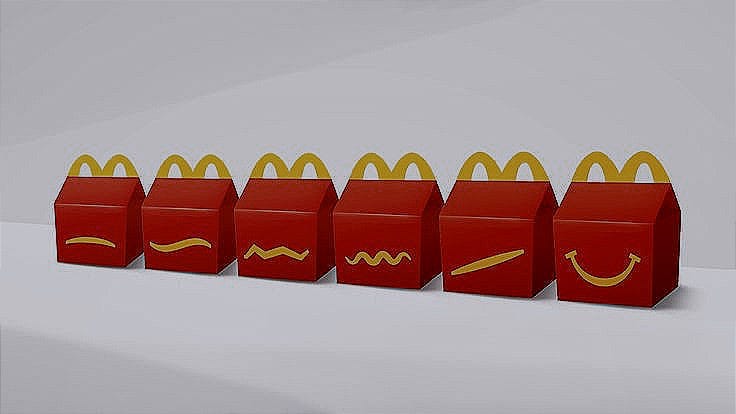
For forty-five years, the medium of that salvation has been unyielding: a bright red cardboard box sporting a massive, curved yellow smile. The smile was not just branding; it was an instruction manual. It was commercial shorthand for mandatory contentment.
In May 2024, McDonald’s stripped that smile entirely.
Across 1,400 restaurants and 2.5 million boxes, the brand removed its most valuable, trademarked visual asset: the big wide yellow smile. The product was stripped of its joyful title “The Happy Meal” and renamed simply: The Meal. In place of the printed grin, children were handed a customizable sheet of stickers showcasing an unfiltered spectrum of emotional states: sadness, anger, confusion, calm, silliness, and fear. The result? The children knew that it was okay to put their choice of the sticker on that bright red cardboard box and say- I am choosing this sticker because that is what I am feeling right now. I am not happy or sad or angry, I am just confused. This was a success on the level of the target audience because they do not have the terminologies to let us know how they are feeling, but they sure know how to express that by drawing or in this case, simply by applying a sticker on a meal box!
From a pure brand marketing perspective, the campaign was an exercise in radical de-escalation:
- The Shock Value of Negative Space: In a media environment defined by relentless sensory overload and neon optimism, taking something away is infinitely louder than adding something new. The unprinted box stopped people mid-scroll and mid-bite because it felt naked.
- The Packaging as an Emotional Dashboard: Fast-food cardboard is not a billboard on a highway; it is an intimate physical artifact that lives directly in a child’s hands for twenty minutes at a table. By turning the box into an interactive canvas, it provided a non-verbal vocabulary. A child didn’t need to endure a high-pressure interrogation from a well-meaning parent; they could simply stick an angry or sad face on their lunch. I wonder if we got the idea of the happy/angry octopus plushie from here! Worth the research I guess?
- Functional Utility Over Corporate Sloganeering: Partnering with BBC Children in Need and embedding QR codes with dedicated parenting resources allowed the brand to offer an actual tool rather than an empty, pastel-colored social media graphic about “mindfulness.”
The Seven-Day Empathy Window: The Inevitable Critique
Yet no corporate campaign—particularly one orchestrated by a multi-billion-dollar fast-food giant built on the very premise of commercial indulgence—can completely escape the gravity of public skepticism.
The British public, possessed of an innate and glorious radar for corporate posturing, immediately identified the campaign’s temporal neatness. The critique was swift, sharp, and entirely warranted:
“You have permission to process existential dread from Monday to Sunday, but come next Monday morning, you better wipe those tears and smile while chewing your nuggets.”
Mental health does not run on a seven-day PR calendar. Human sorrow does not pack up its bags when the corporate communications department moves on to its summer campaign. There is an inherent, deadpan dissonance in asking an anxious ten-year-old to diagnose their emotional fractures via adhesive cardboard stickers while dipping fries in barbecue sauce. A temporary packaging redesign, no matter how brilliantly executed by award-winning agencies, is not a substitute for sustained systemic care or accessible adolescent healthcare.
And yet, despite the valid corporate cynicism, the campaign touched a nerve that pure advertising rarely reaches. It forced us to confront the silence at our own tables. It forced some people to talk about the elephant in the room. The need of the hour? In a lot many ways, yes!
From Cardboard Boxes to Kitchen Tables
The irony of modern protection is that in our frantic attempt to keep children “in sweetness”—pulling levers behind the curtain like the frantic adults in Taylor Swift’s Robin—we often construct fragile glass cages. When 74% of parents believe it is their moral duty to prevent a child from feeling pain, and 48% of kids learn to paste on a smile to keep their parents comfortable, love curdles into censorship.
The real antidote isn’t found in a cardboard box, nor is it manufactured by an agency during Mental Health Awareness Week. It exists in the quiet, mundane grace of the kitchen table.
During my time living in the UK, navigating unfamiliar streets with the quiet vulnerability of being far from home, I encountered parents who practiced a different kind of courage. They gave people—and their own children—the radical space to be okay with not being okay. I watched parents genuinely listen over the smallest, most ordinary moments: not mocking or belittling a child who suddenly decided they wanted French fries with their burrito instead of nachos, treating that tiny pivot not as a daily disruption, but as an emerging voice learning how to choose.
That micro-moment of validation carries the exact same emotional weight as being there for the monumental crashes. It is the space Lorelai Gilmore carved out for Rory: listening without judgment to who they like, staying up to hold space through a shattering teenage heartbreak even when there is an exam the next morning, and speaking to them as independent beings rather than emotional property or extensions of an adult’s unfulfilled ambitions.
True protection is not curating an artificial paradise where no one falls. It is resisting the urge to sugarcoat the world. Children are supposed to stumble. They are supposed to fall for the wrong person, pick the wrong menu item, endure the ache of disappointment, and discover that happiness is an episodic visitor, not a permanent resident.
When we shield them from hurt, we don’t preserve their innocence—we guarantee their disillusionment. We send them into adulthood armed with synthetic optimism, only to watch them fracture against the first brutal, inevitable collision with reality.
McDonald’s peeled the smile off 2.5 million boxes for seven days to make a point about emotional honesty. But the real lesson doesn’t belong on a fast-food counter. It belongs in our willingness to look at someone we love—holding a heavy heart, or just an unconventional plate of fries—and say: I see you. You don’t have to smile for me.
References
- Leo Burnett UK. 2024. “The Meal.” Creative Case Study. London: Leo Burnett UK. Leo Burnett: The Meal.Leo Burnett
- Ready10. 2024. “McDonald’s Launches ‘The Meal’: New Integrated Campaign Removes the Iconic Smile from Happy Meal Boxes® for the First Time Ever to Mark Mental Health Awareness Week.” Press Release. London: Ready10 / FAB News. Ready10 FAB News Announcement.
- McDonald’s UK. 2024. “McDonald’s Removes Iconic Smile from Happy Meal® Boxes for the First Time Ever to Mark Mental Health Awareness Week.” McDonald’s UK Newsroom. McDonald’s UK Newsroom Announcement.
- BBC Children in Need. 2024. “Supporting Emotional Well-being with McDonald’s UK.” Mental Health Awareness Week Partnership Hub. London: BBC Children in Need.
- The Children’s Society. 2023–2024. The Good Childhood Report. London: The Children’s Society.
- NHS England. 2023. Mental Health of Children and Young People in England, 2023. NHS Digital / Office for National Statistics.
- Swift, Taylor. 2024. “Robin.” Track 29 on The Tortured Poets Department: The Anthology. Republic Records.
- Joshi, Prasoon, Shankar Mahadevan, Ehsaan Noorani, and Loy Mendonsa. 2007. “Maa.” In Taare Zameen Par, directed by Aamir Khan. Mumbai: T-Series.
- Kirkire, Swanand, and Shantanu Moitra. 2009. “Give Me Some Sunshine.” In 3 Idiots, directed by Rajkumar Hirani. Mumbai: Vinod Chopra Films / T-Series.
- Sherman-Palladino, Amy. 2000–2007. Gilmore Girls. Warner Bros. Television.
- For a visual breakdown of how the creative agency and McDonald’s executed the smile-free packaging activation, take a look at the McDonald’s – The Meal Case Study. This showcases the physical boxes and public reactions during the UK campaign week, providing direct visual context for the creative strategy discussed in this essay.


Let me know your thoughts