
“Cause I am real tough kid,
I can handle it.
They say babe you gotta fake it till you make it
And I did.”
Headout.
A word I came across on a random July afternoon while scrolling through LinkedIn.
At the time, I didn’t know much about the company. What I did know was that it was a late-stage startup operating in the travel industry. During my time in the UK, I had occasionally stumbled across Headout while looking up tickets to attractions in London. I knew they sold experiences. I knew they existed. And that was about it.
Like most pieces of information we encounter every day, this one quietly drifted to the back of my mind, filed away somewhere between forgotten passwords and half-finished to-do lists. By the time I came across a job posting from Headout on LinkedIn months later, I had almost completely forgotten about it.
Almost.
What happened next was, admittedly, not part of any grand career plan. In fact, my ”grand career plan” and I have never really been on speaking terms. For a really long time.
The Application Journey
I applied to Headout sometime around June or July 2025 through a LinkedIn job posting. The process itself was fairly straightforward. The day I applied, however, was about as ordinary as a day could possibly be.
Back then, I had perfected the art of routine. I would wake up around eight or nine in the morning, make myself a bowl of oats or granola, cut up some fruit, put on an episode or two of F.R.I.E.N.D.S, and worry about my career. That last activity occupied more time than I’d care to admit.
After spending forty-five minutes with my breakfast and an unhealthy amount of overthinking, I would begin my daily pilgrimage across LinkedIn, Indeed, Naukri, company career pages, and every other job platform known to humanity. Armed with a CV, determination, and increasingly questionable levels of optimism, I was essentially hoping that somebody, somewhere, would offer me a job in… well, anything.
On one such wildly eventful day, I came across two job postings from a company called Headout. What caught my attention first wasn’t the role itself, but the logo. It was one of the most intriguing logos I had seen in a long time—something I would later learn was inspired by the iconic Led Zeppelin blimp. Naturally, I clicked.
As I scrolled through the job description, one particular line caught my eye. It said something along the lines of: “If you’re organised like Monica from F.R.I.E.N.D.S…”
That was it. That was all it took.
Somewhere between Monica Geller and my own inability to resist a good pop-culture reference, I had already decided I wanted to apply. Long before the virtual interviews, the assessments, or the onboarding process, I found myself developing an affinity for the company. There was something refreshingly human about the way the role had been written. It felt conversational. Playful. Unapologetically itself.
In my head, I made a quiet decision: One day, I’m going to work here.
What followed was perhaps my most thorough piece of investigative journalism to date. I searched Glassdoor. I searched Reddit. I searched LinkedIn. I searched every corner of the internet that could possibly tell me what people thought about Headout. I wanted to know whether the company I had imagined from a single job description actually existed in reality. To my surprise, the reviews seemed to support the impression I had formed.
And then there was the application process itself. Anyone who has spent time job hunting knows the ritual. Upload your CV. Re-enter every detail from your CV into seventeen separate fields. Confirm information already visible on your CV. Create a password you’ll never remember. Receive an automated rejection email three weeks later. Headout somehow managed to avoid that experience entirely. The application process felt straightforward, respectful of my time, and refreshingly free from unnecessary hurdles. At that point, Headout had officially become my favorite company that I didn’t yet work for.
And trust me, I don’t say that lightly. Although, admittedly, I do have a flair for the dramatic.
Things moved surprisingly quickly after that. Within about ten days of submitting my application, I received an invitation for the first online assessment. Then came the recorded video interview, followed by the subsequent rounds.
Now, this is where my affinity for Headout really started to grow. I should probably confess something: I am terrible at interviews. Not because I lack experience. Not because I don’t prepare. I simply panic. The moment someone asks me, “Tell me about yourself,” my brain abandons all professional aspirations and transforms into an overexcited Labrador chasing five tennis balls at once.
I’ve always struggled with highly structured interviews. The kind where both parties already know the script and spend the next forty minutes pretending they don’t. So, before my first interview, I prepared accordingly. I had my notes ready, a gallon of water beside me, and a carefully rehearsed answer to the question I dread most.
The funny thing is, that question never came. At least not in the way I expected.
For the first time in a very long time, an interview felt less like an interrogation and more like a conversation. The discussion flowed naturally. I found myself talking rather than performing. And somewhere during that conversation, I had a thought: I think I’ve found my match.
Apologies for borrowing terminology from the dating world, but job hunting and online dating do have a surprising amount in common. You’re trying to present the best version of yourself. They’re trying to decide whether you’re compatible. Everyone is hoping to avoid rejection. And every now and then, you come across a connection that just feels… easy.
The Big Day: The Onboarding Bubble
There is a very specific kind of excitement that comes with joining a new company. It sits somewhere between the first day of school and the first episode of a TV show everyone has been recommending for years. You don’t really know what to expect, your nerves are competing with your enthusiasm, and you are secretly praying you’ve made the right decision.
That was me on my first day at Headout.
After weeks of interviews, assessments, and wondering if I had somehow imagined the entire experience, I was finally here. The first thing that struck me wasn’t a rigid policy document or a daunting organizational chart; it was the people. Real, enthusiastic, smiling people who somehow managed to make a virtual onboarding feel surprisingly warm.
Now, if you’ve ever attended corporate training before, you know that “icebreakers” can be an absolute minefield. There is always a tiny, panicked voice in your head praying nobody asks you to “describe yourself using a fruit.” Thankfully, this wasn’t that. The conversations felt natural, and people were genuinely curious about one another. Between the shared laughter, the occasional awkward Zoom silences, stories from different backgrounds, and very competitive games of Pictionary, a group of complete strangers slowly began feeling a little less like strangers. Looking back, I think that’s something Headout does remarkably well: it doesn’t just introduce you to a company; it introduces you to a community.
Our trainers deserve a special mention. Training can easily devolve into an endless, mind-numbing parade of slide presentations, corporate acronyms, and information overload. Instead, ours felt incredibly thoughtful. Questions were actively encouraged, and curiosity was rewarded. No one made you feel silly for asking something twice—or even three times. There was an unspoken understanding that learning wasn’t about pretending to know everything; it was about becoming comfortable enough to admit when you didn’t. As someone who routinely needs to ask approximately four hundred questions before feeling remotely confident, this environment suited me perfectly.
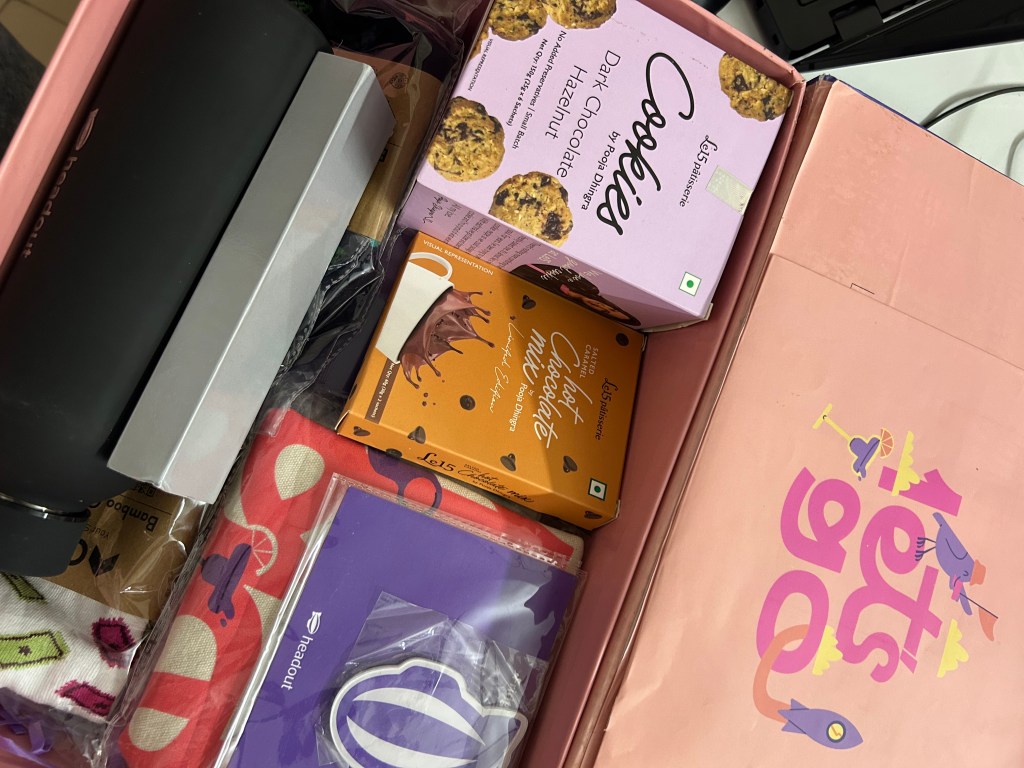
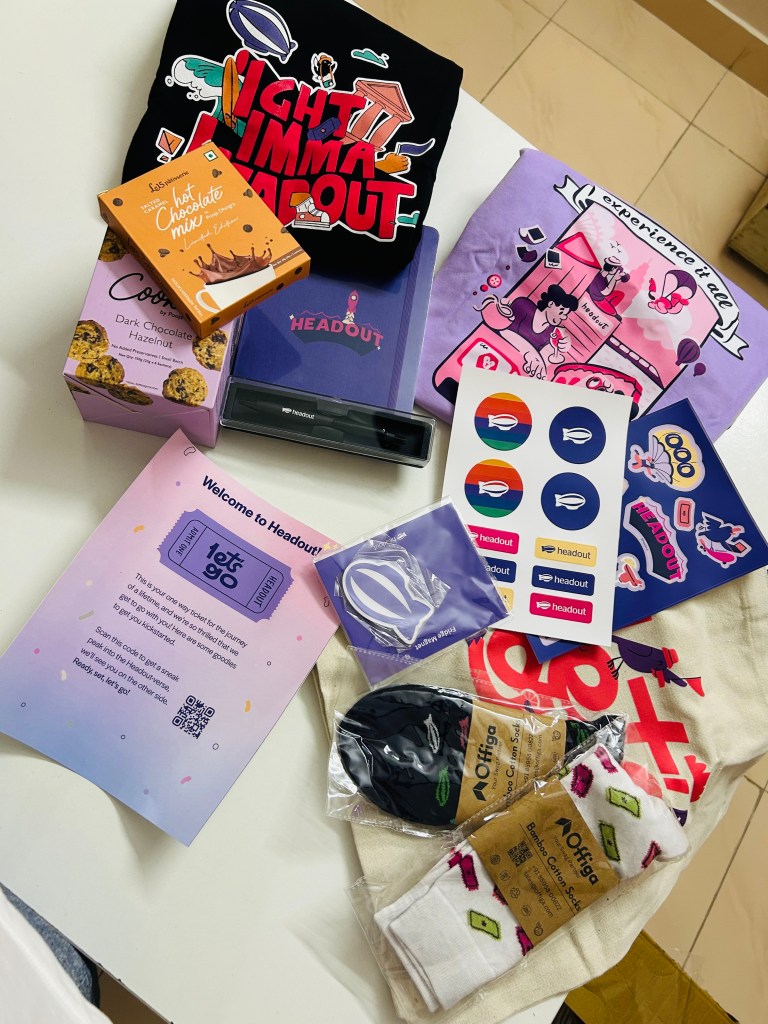
Then came what was arguably one of my favorite moments of onboarding: the Headout swag kit.
Now, I fully acknowledge that branded merchandise should not bring an adult this much joy. And yet, opening that package felt oddly special. The notebook, the T-shirts, the stickers—the little details had clearly been put together with genuine care. None of it was strictly necessary, which is precisely why it mattered. Good company merchandise doesn’t make you love your job, but it does make you feel like someone expected you to be there. Like they had prepared a place for you before you even arrived. It sounds like a small thing. It isn’t—especially when you’re starting somewhere completely new.
By the end of training, I realized something had quietly shifted. I had joined Headout expecting to learn a new role. Instead, I had started learning an entirely new way of thinking about work. Some companies train you to blindly complete tasks; others teach you to understand why those tasks exist in the first place. Headout, I was beginning to realize, belonged firmly in the second category.
It was a beautiful, comforting realization.
The Reality Check: Finding My Footing on the Frontline
As it turns out, understanding the theory of how a fire starts is very different from standing in front of a live blaze with a single bucket of water. My cozy training bubble was about to meet the fast-paced, high-stakes reality of live customer experience.
On August 4th, 2026, I officially hit my 365-day mark in this role. One full year. But if you had told me six months ago that I’d be hitting this milestone, I probably would have laughed—or cried. Or both. Dramatic, remember?
Frontline operations require a unique kind of resilience. I came in as someone driven deeply by words, long-form narratives, and the open spaces of creative thinking. I had romanticized what my workday would look like—imagining fixed creative rhythms and hours spent painting cities in vibrant prose.
Instead, stepping into the customer workflows was an intense shock to the system.
The first six to seven months tested me in ways I hadn’t anticipated. It was fast, relentless, and emotionally demanding. You are resolving escalations in real-time for travelers whose dream vacations are hanging in the balance, often navigating high frustration over issues completely outside your control. For a while, I felt out of my depth and found myself caught in a bit of a rut. It is an exhausting feeling when your daily routine is consumed by high-urgency problem-solving while your creative instincts feel tucked away in the background. I watched colleagues effortlessly thrive in operational problem-solving or transition seamlessly into other functions, and I wondered if I’d ever find my own rhythm or figure out where I truly fit.
The Eighth-Month Epiphany: An Accidental Masterclass
And then, right around the middle of my eighth month, something shifted. It wasn’t a sudden corporate miracle or a magical drop in ticket volumes. It was simply a change in the lens I was looking through.
I woke up to a perspective I had been completely oblivious to: I was sitting through an intensive, unfiltered masterclass in business growth and consumer psychology.
Suddenly, those high-stress escalations weren’t just hurdles; they were data points. I was learning the exact, raw pain points of global travelers. I was discovering what makes a guest lose confidence in a brand, and what tiny gestures of genuine empathy can turn a stressful moment into lifelong brand loyalty. More than that, I was getting a rare, backstage view of our supply mechanics. I began to see firsthand how seamless partnerships elevate the guest experience, and how stringent policies, miscommunications, or unexpected operational delays on the partner side can ripple through to create friction for the traveler.
I had spent months viewing the role as a waiting room, waiting for my “real” creative career to start. In reality, Headout had handed me the ultimate launchpad. How can you write compelling content, design thoughtful narratives, or drive growth for a travel tech brand if you don’t truly understand what happens on the ground?
My aspirations haven’t changed—my heart is still firmly set on content, brand storytelling, and creative strategy where I can let my love for narrative take center stage. But the overwhelm has been replaced by purpose. Instead of feeling weighed down by the daily workflow, I’m using every single interaction as building blocks for what comes next.
Breaking the Script: Capability Over Pedigree
I grew up with a very specific, traditional script about careers: if you are lucky enough to be given a job, you stick to the safe path. You put your head down and stay within the lines. To switch paths—especially into marketing or creative strategy—the unspoken rule, particularly in traditional corporate environments, is that you need the armor of formal credentials. You need the exact degrees, the neat certifications, or a prestigious stamp of approval before anyone even considers giving you a seat at the table.
What I found at Headout completely flipped that script.
Headout looks far beyond formal qualifications on a resume; it genuinely values who you are, how you think, your drive, and the unique perspectives you bring to the table. It is an environment that evaluates capability and curiosity over rigid pedigrees, giving you the room and encouragement to grow.
I lucked out in the absolute best way possible with my managers. In an industry where management can so easily become an exercise in micromanagement, my managers became a safe harbor. Their unwavering support changed everything for me. Instead of boxing me into a single workflow, they gave me the psychological safety and the encouragement to lift my head up, look at the bigger picture, and actively shape what I want my career journey to look like.
For the longest time, I didn’t have a clear roadmap. I was just trying to keep pace. But this past year on the frontlines didn’t dim my creative spark; it sharpened it.
This journey taught me that I am, at my core, a storyteller—and that understanding real human behavior is the best foundation any writer could ask for. The experience I’m gaining right here—learning how humans make decisions, navigate stress, travel, and experience the world—is the most valuable qualification I could ever earn.
It has now been 414 days of me being a Headouter. It hasn’t been a flawless, glossy year, and I’ve certainly had moments where the learning curve felt steep. But it has been deeply authentic. I am embracing this experience as a launchpad, not a detour. The story is just getting started, and for the first time in a very long time, I am excited to write the next chapter.
If you had told me a year ago that I’d navigate 365 days of frontline customer experience and emerge with more clarity than ever, I wouldn’t have believed you. But there’s a poetic irony to it: learning to navigate the chaotic, unpredictable world of travel operations helped me find my own direction. Turns out, you don’t need an MBA to understand how the world works—you just need a little grit, an endless supply of questions, and a workplace that values people over paper.
If this chapter of my life had a theme song, it would undoubtedly be “Dog Days Are Over” by Florence + The Machine. It’s got that exact mix of frantic energy, a thumping baseline of resilience, and that sudden, triumphant realization that you’re finally running toward the light. The uncertainty is over; the storytelling phase has begun.


 Penny's World